
Quick answer
After a box truck crash, the truck's weight rating and how it was being used shape which rules and insurance may apply. Federal trucking rules generally reach vehicles of 10,001 pounds or more used in interstate commerce, and a CDL is generally required for single trucks rated at 26,001 pounds or more. If the truck was rented, federal law may limit the rental company's responsibility unless it was negligent itself.
Box trucks are everywhere in the Valley: furniture and appliance deliveries, local freight runs, and rental moving trucks driven by people moving across town. If one hit you, a box truck accident lawyer in Phoenix may start with two questions: how heavy is the truck, and who was driving it for what purpose? Those answers can change which safety rules apply, whether the driver needed a commercial license, and how much insurance may be available.
This guide explains those questions in plain English. It does not say that any company is or is not responsible for any crash. For the bigger picture, start with our Phoenix truck accident guide.
What counts as a box truck
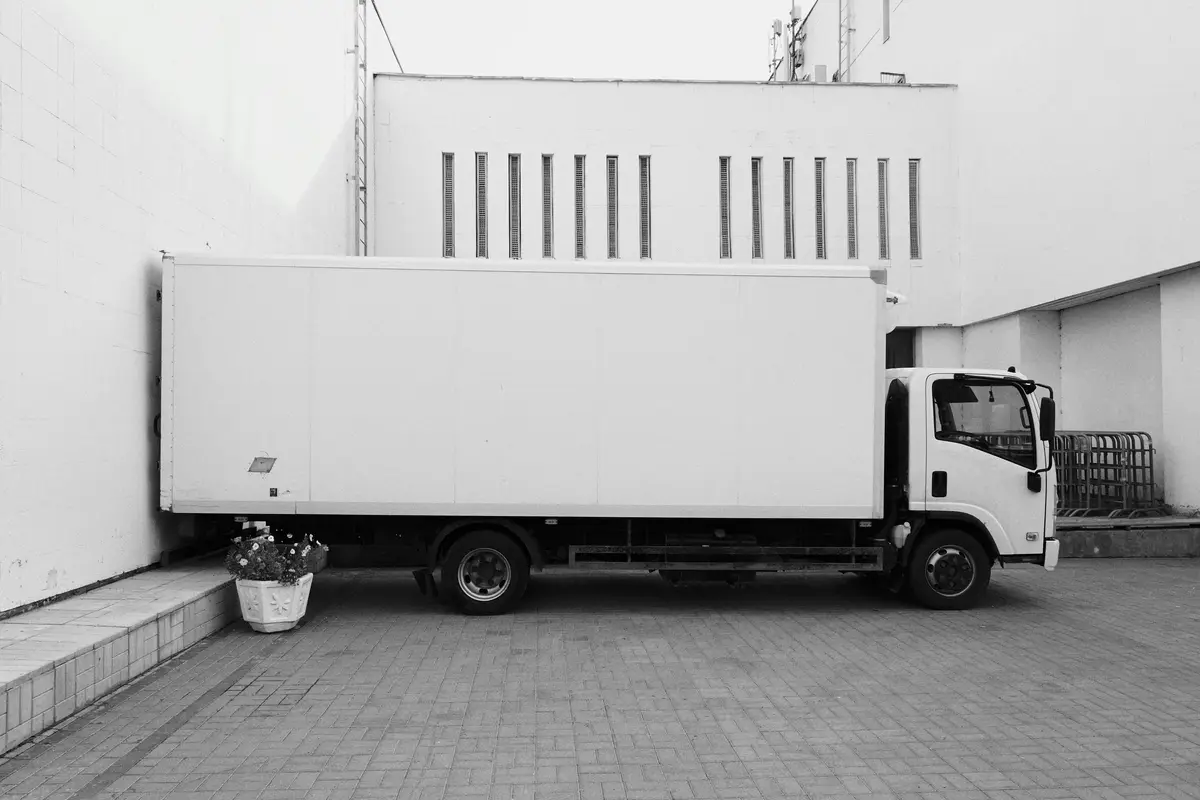
A box truck, also called a straight truck, has the cargo box attached to the same frame as the cab. There is no separate trailer. These trucks come in many sizes, from small cube vans to large trucks with lift gates and air brakes.
That size range is the reason box truck cases can be confusing. A small rental truck and a large freight box truck can look similar from the road but fall under very different rules. The number that matters most is usually the gross vehicle weight rating (GVWR), the maximum loaded weight set by the manufacturer. It is normally printed on a label inside the driver's door.
Why box truck crashes matter in Phoenix
The West Valley has many warehouses and distribution centers. Box trucks leave those sites for last-mile routes into neighborhoods, shopping centers and business parks, often by way of the Loop 303 and Loop 202. Local routes mean frequent stops, tight turns, backing into loading docks and double parking on busy streets.
Phoenix also sees a steady flow of people moving in, out and around the Valley. Many rent a moving truck for a day and drive it on freeways and residential streets with little or no experience handling a vehicle that size. For local crash data, see ADOT's Arizona Motor Vehicle Crash Facts (opens in a new tab).
Common box truck crash patterns
Rear-end crashes. A loaded box truck needs more distance to stop than a car. Drivers who are new to a rental truck may not expect that.
Blind spot and lane-change crashes. A tall cargo box blocks the driver's view, and rental trucks often have no rear window to look through.
Rear underride. A car can slide under the back of a box truck if the rear guard is missing, damaged or too weak. Our underride truck accident guide explains rear guard rules and blind spot crashes in more detail.
Backing crashes at docks, driveways and parking lots. Arizona law bars backing unless it can be done with reasonable safety and without interfering with other traffic (A.R.S. 28-891 (opens in a new tab)).
Overloaded or shifting cargo. Too much weight, or cargo that slides inside the box, can affect braking and handling. Cargo that falls out of an open door can strike other cars.
Low clearance strikes at overpasses, drive-throughs and parking garages, which can drop debris into traffic.
What to do after a box truck accident
Get medical care and follow your doctor's advice.
Call police and get the report number.
Photograph the truck, including the company name, license plate, any USDOT number, and the rental company's name if it is a rental. If you can do so safely, photograph the weight label on the driver's door frame.
Ask the driver who they drive for. If it is a rental, ask whether it was rented for personal use or for a business. Write down the answer exactly as given.
Get insurance information for the driver and, if offered, any rental coverage paperwork.
Look for video. Loading docks, storefronts and doorbell cameras may have captured the crash. Ask quickly, because some systems record over footage.
Do not give a recorded statement to any insurer before you get legal advice.
Ask a lawyer about preservation letters for the truck, telematics, rental records and cargo records.
Federal rules: why the 10,001-pound line matters
Most federal trucking safety rules apply to a "commercial motor vehicle." For a vehicle used in interstate commerce to carry property, that generally means a gross vehicle weight rating, gross combination weight rating, or actual weight of 10,001 pounds or more, whichever is greater (49 CFR 390.5 (opens in a new tab)).
When a box truck meets that definition, rules on driver qualification (49 CFR Part 391 (opens in a new tab)), hours of service, and inspection and maintenance (49 CFR Part 396 (opens in a new tab)) may apply. Cargo securement rules may apply too (49 CFR 393.100 (opens in a new tab)).
Two points make this tricky:
Interstate or not. The federal definition is tied to interstate commerce. A truck that only runs inside Arizona may fall under Arizona's motor carrier safety law instead. That law treats a truck used in intrastate commerce as a commercial motor vehicle at 26,001 pounds or more, compared with 10,001 pounds for interstate trucks (A.R.S. 28-5201 (opens in a new tab)), and the Arizona Department of Transportation adopts motor carrier safety rules under A.R.S. 28-5204 (opens in a new tab).
Business use or personal use. The rules are aimed at transportation in commerce. Someone driving a rented truck to move their own belongings may not be covered by the federal carrier rules, while a business using the same truck may be. The federal rules list an exception for the occasional transportation of personal property by individuals not for compensation and not in the furtherance of a commercial enterprise (49 CFR 390.3(f)(3) (opens in a new tab)).
When a CDL is and is not required
A heavy truck does not always mean a commercial driver's license. Under the federal CDL rules, a single "heavy straight vehicle" (Group B) has a gross vehicle weight rating or weight of 26,001 pounds or more. Smaller vehicles need a CDL only in narrower cases, such as vehicles designed to carry 16 or more people, including the driver, or vehicles carrying placarded hazardous materials (49 CFR 383.5 (opens in a new tab)). These CDL rules apply to driving in interstate and intrastate commerce alike (49 CFR 383.3 (opens in a new tab)).
That means many box trucks, including many rental moving trucks, can be driven legally on a regular driver's license. The driver may have had no special training on stopping distance, blind spots or loading. That does not decide who is at fault, but training, experience and instructions given to the driver may be part of the investigation.
Insurance: why weight changes the picture
The federal minimum insurance levels in 49 CFR 387.9 (opens in a new tab) apply to for-hire carriers moving property in interstate or foreign commerce, plus certain hazardous materials carriers (49 CFR 387.3 (opens in a new tab)). For for-hire general freight in vehicles with a gross vehicle weight rating of 10,001 pounds or more, the minimum is $750,000. That subpart generally does not apply to vehicles rated under 10,001 pounds unless they carry certain hazardous materials, and it does not cover private carriers hauling their own non-hazardous goods.
Arizona has its own rules. A.R.S. 28-4032 lists who must meet Arizona's motor carrier financial responsibility rules, including commercial vehicles with a declared gross weight of more than 20,000 pounds (A.R.S. 28-4032 (opens in a new tab)). For non-hazardous property, A.R.S. 28-4033 sets combined single limit liability minimums of $300,000 for vehicles from 20,001 to 26,000 pounds and $750,000 for vehicles over 26,000 pounds (A.R.S. 28-4033 (opens in a new tab)).
| Box truck situation | Rules that may apply |
|---|---|
| Under 10,001 lbs | Arizona minimum auto liability limits; often a business or commercial auto policy |
| 10,001 lbs or more, for-hire interstate general freight | Federal $750,000 minimum under 49 CFR 387.9 |
| Over 20,000 lbs declared gross weight, commercial use in Arizona | Arizona motor carrier minimums under A.R.S. 28-4033 |
More than one row may apply to the same truck.
For smaller trucks, Arizona's basic minimums for policies issued or renewed beginning July 1, 2020, are $25,000 for injury or death of one person, $50,000 for two or more people, and $15,000 for property damage (A.R.S. 28-4009 (opens in a new tab)). These are floors. Many businesses carry more, and other policies may also apply. Our guide to truck insurance limits covers the federal tiers in more depth.
Rental moving trucks and the Graves Amendment
When a rented truck causes a crash, people often assume the rental company is responsible. Federal law says otherwise in many cases. Under 49 U.S.C. 30106 (opens in a new tab), often called the Graves Amendment, a company in the business of renting or leasing vehicles generally cannot be held responsible under state law just because it owns the vehicle.
There are limits to that protection:
The company's own negligence. The protection does not apply if there was negligence or criminal wrongdoing by the owner. For example, an investigation might look at whether the truck was properly maintained before it was rented.
Insurance laws still apply. The statute does not override state laws that set financial responsibility or insurance standards for vehicle owners, or state laws holding rental companies liable for failing to meet those requirements. For vehicles covered by Arizona's motor carrier insurance rules (generally commercial use over 20,000 pounds declared gross weight), the lessor of a leased or rented vehicle must either cover the lessee under its own policy or require the lessee to meet the requirements (A.R.S. 28-4033(B) (opens in a new tab)). A truck rented for a personal move may fall outside those rules.
The driver who rented the truck can still be responsible for their own careless driving. If they were driving for a business, that business may be responsible too. The rental contract, any coverage bought at the counter, and the renter's own auto policy all need to be reviewed.
Who may be responsible
Depending on the facts, an investigation may look at:
The driver.
The driver's employer, or the business that hired the truck.
The company that loaded the cargo.
The rental or leasing company, if it was negligent itself.
A maintenance shop, or a manufacturer if a defect is suspected.
Arizona assigns fault among everyone who contributed to a crash, and each defendant is generally responsible only for its own share (A.R.S. 12-2506 (opens in a new tab)). Our guide on who is liable in a truck accident explains how responsibility is sorted out. If the box truck was making parcel deliveries for a contractor, our delivery truck accident lawyer guide covers those contractor questions.
Arizona deadlines and fault rules
Two-year deadline for most injury lawsuits (A.R.S. 12-542 (opens in a new tab)).
Public entity trucks. If a city or other public entity owns the truck, a notice of claim is generally due within 180 days (A.R.S. 12-821.01 (opens in a new tab)), and a lawsuit generally within one year (A.R.S. 12-821 (opens in a new tab)).
Comparative fault. Your damages may be reduced by your share of fault but are not automatically barred (A.R.S. 12-2505 (opens in a new tab)).
How we can help
A lawyer can check the truck's weight rating and registration, identify who owned, rented and operated it, request the rental contract and every policy that may apply, and send preservation letters. Our contingency fee means no attorney fee unless there is a recovery. The fee percentage and how case costs are handled depend on the case, and if there is no recovery you may still owe case costs. Attorney Gil Hacohen speaks English, Hebrew and Spanish. To talk through your situation, request a free case review.
Talk to a Phoenix truck accident lawyer for free
Tell us what happened. We'll review your situation and explain your options. There's no fee unless you recover money.
Frequently asked questions
Is a box truck a commercial motor vehicle?
It depends on its weight and use. Under 49 CFR 390.5, a vehicle used in interstate commerce to carry property generally counts as a commercial motor vehicle if its gross vehicle weight rating, or its actual weight, is 10,001 pounds or more. Many box trucks are at or above that line, and some smaller ones are below it. For a truck used only within Arizona, state law generally sets the commercial motor vehicle line at 26,001 pounds or more (A.R.S. 28-5201). The weight label on the truck and its use at the time of the crash need to be checked.
Does a box truck driver need a CDL?
Not always. Under 49 CFR 383.5, a single truck generally needs a commercial driver's license when its gross vehicle weight rating or weight is 26,001 pounds or more, or when it carries placarded hazardous materials. Many box trucks are rated below 26,001 pounds, so the driver may only need a regular license. The federal CDL rules apply to both interstate and intrastate driving (49 CFR 383.3).
Can I make a claim against the rental company if a rented moving truck hit me?
Federal law, often called the Graves Amendment (49 U.S.C. 30106), generally protects a business that rents or leases vehicles from being held responsible under state law just because it owns the vehicle. That protection does not apply if the rental company was itself negligent or engaged in criminal wrongdoing, and it does not override state insurance and financial responsibility laws. Whether any of that applies depends on the facts.
What insurance covers a box truck crash?
It depends on who was driving and why. A business truck may carry a commercial auto policy. A person driving a rental truck may have their own auto policy, coverage bought at the rental counter, or both, and the rental company may carry coverage required by state law. Which policies apply turns on the policy terms.
How long do I have to file a claim after a box truck accident?
Most Arizona injury lawsuits must be filed within two years under A.R.S. 12-542. If a government-owned truck is involved, a notice of claim is generally due within 180 days under A.R.S. 12-821.01, and a lawsuit within one year under A.R.S. 12-821.