
Quick answer
An underride truck accident happens when a smaller vehicle slides under the rear or side of a trailer. Federal rules require rear impact guards on most trailers, but there is currently no federal requirement for side underride guards. Blind-spot ("no-zone") crashes, such as right-turn squeezes, are a common lead-in to side underride.
An underride truck accident happens when a smaller vehicle slides under the back or side of a trailer. A trailer's floor usually sits higher than the hood of a car. In an underride crash, the trailer can miss the car's bumper and crumple zone and strike the windshield and passenger area instead.
Many underride crashes begin with a blind spot. A truck changes lanes or turns right without seeing a car beside it, and the car ends up under the trailer. This guide explains how these crashes happen, what federal rules require, and what to do next. For an overview of truck crash claims, see our Phoenix truck accident lawyer page.
Why underride and blind-spot crashes matter in Phoenix
Phoenix-area freeways such as I-10, I-17, Loop 101 and Loop 202 carry heavy truck traffic. Lanes merge and split quickly at interchanges, and traffic can stop suddenly. A stopped trailer in a travel lane or on the shoulder can be hard to judge at night or in dust.
On surface streets, distribution centers and job sites bring tractor-trailers onto city roads with bike lanes and crosswalks. Wide right turns at intersections are a daily event. For local crash figures, see ADOT's Arizona Motor Vehicle Crash Facts (opens in a new tab).
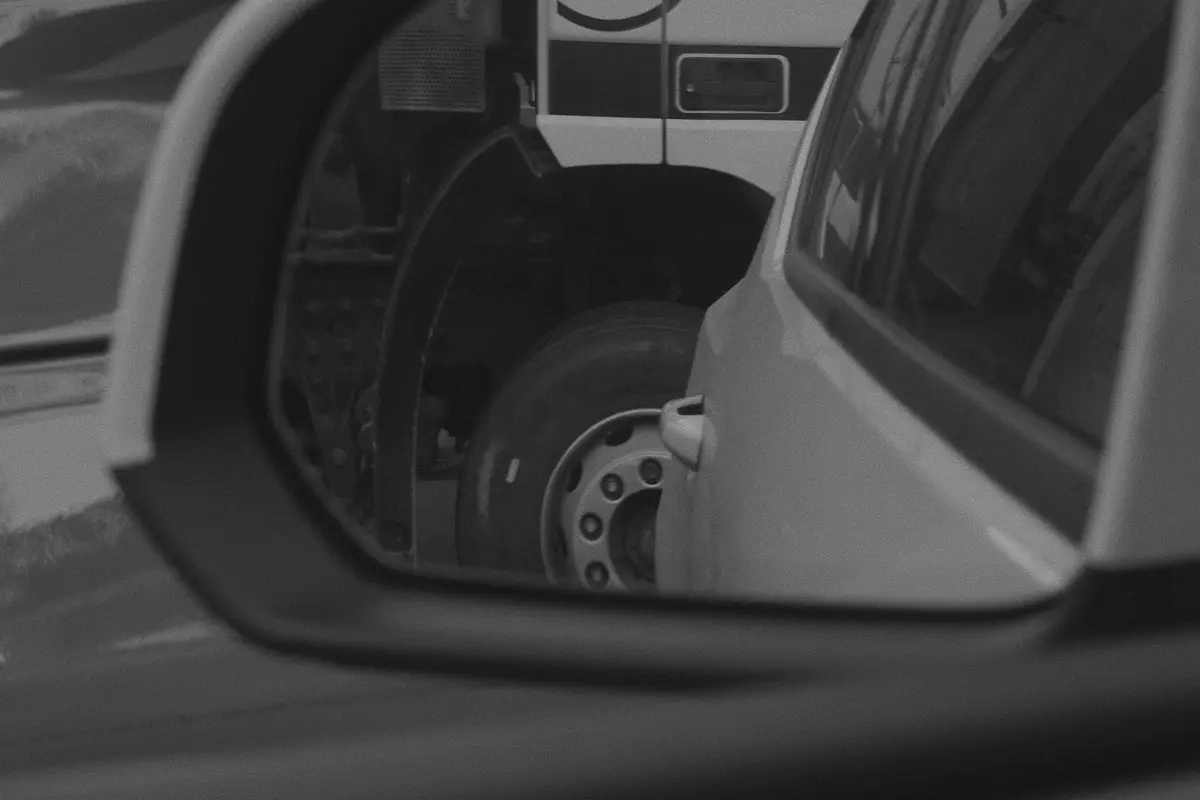
Rear underride and rear impact guards
Federal rules require a rear impact guard on each trailer and semitrailer with a gross vehicle weight rating of 10,000 pounds or more that was made on or after January 26, 1998. The guard must meet Federal Motor Vehicle Safety Standard No. 223, and the trailer must meet FMVSS No. 224, in the versions in effect when the trailer was made (49 CFR 393.86(a)(1) (opens in a new tab)). NHTSA upgraded both standards in a 2022 final rule that requires stronger, more energy-absorbing guards on newly made trailers, with a compliance date of July 15, 2024 (87 FR 42339 (opens in a new tab)).
For those trailers, the rule sets basic size and position limits:
The bottom of the guard's horizontal bar may not be more than 22 inches (560 mm) above the ground.
The bar must reach to within 4 inches of each side of the trailer.
At heights of 22 inches or more above the ground, its rear surface must be within 12 inches of the back of the trailer.
Some trailer types are excluded from that part of the rule. They include pole trailers, pulpwood trailers, low chassis vehicles, special purpose vehicles, wheels back vehicles, certain road construction trailers and trailers in driveaway-towaway operations (49 CFR 393.86(a)(1) (opens in a new tab)). Older vehicles fall under a separate standard with a 30-inch height limit (49 CFR 393.86(b) (opens in a new tab)).
Carriers must also keep vehicle parts in safe and proper operating condition at all times, including the parts covered by Part 393 (49 CFR 396.3 (opens in a new tab)). A bent, rusted or missing guard may raise questions about inspection and maintenance.
Side underride: no federal mandate
Rear guards are required. Side guards, as of October 2026, are not. The National Highway Traffic Safety Administration (NHTSA) published an advance notice of proposed rulemaking on side underride guards on April 21, 2023 (88 FR 24535 (opens in a new tab)). That is an early step, not a final rule, and no final rule had been published in the Federal Register as of October 2026. In a 2025 notice, NHTSA denied a defect petition about trailers without side guards, saying the issues raised should be addressed through its rulemaking (90 FR 14409, April 1, 2025 (opens in a new tab)).
No mandate does not mean no claim. A side underride case often turns on how the crash started: an unsafe lane change, a turn into a car's path, a trailer stopped without proper warning, or poor lighting or reflective markings.
Blind spots, the "no-zone" and right-turn squeezes
Trucks have large areas around them where the driver has little or no view. These are often called "no-zones." They usually include the area directly in front of the cab, directly behind the trailer, and along both sides, especially the right side.
Arizona law says a driver must stay within a single lane and may not move from it until the driver has first made sure the move can be made safely (A.R.S. 28-729 (opens in a new tab)). It also says no one may turn or move right or left on a roadway unless the move can be made with reasonable safety, and requires a turn signal (A.R.S. 28-754 (opens in a new tab)).
The right-turn squeeze
A long truck often swings left before turning right. That can open a gap on the right that a car, cyclist or scooter rider moves into. The truck then turns across that gap and traps the smaller vehicle.
Arizona law addresses this. Right turns must be made as close as practicable to the right-hand curb. The driver of a vehicle or combination at least 40 feet long, or at least 10 feet wide, may leave the lane as needed for a right turn "in a manner that avoids contact with another person or vehicle" (A.R.S. 28-751 (opens in a new tab)). Fault in these crashes can be shared. Arizona's comparative fault rules are covered below.
Mirrors and camera systems
Every truck and truck tractor must have two outside rear-vision mirrors, one on each side, placed to show the driver the highway to the rear along both sides (49 CFR 393.80 (opens in a new tab)). Drivers must also be satisfied that their mirrors are in good working order before driving (49 CFR 392.7 (opens in a new tab)).
Many fleets add blind-spot cameras, side sensors or camera-based mirror systems. If a truck had them, their recordings and settings may be useful evidence. Whether a camera system can legally replace a mirror depends on federal exemptions and should be checked case by case.
What to do after an underride or blind-spot crash
Get medical care right away. Underride crashes often cause head, neck and upper-body injuries. Follow your doctor's advice.
Call 911 and get the report number. Note which agency responded.
Photograph the trailer's rear and sides, if you or someone with you can do so safely. Capture the guard, lights, reflective tape and any damage.
Write down the truck and trailer details. That includes the company name, USDOT number and trailer number. The tractor and trailer may belong to different companies.
Find witnesses and video. Nearby businesses, buses and other drivers may have cameras.
Avoid recorded statements to the trucking company's insurer before you get legal advice.
Ask a lawyer about preserving the trailer. The guard, its welds and its bolts can be repaired or the trailer put back in service. A preservation letter asks the owner not to change or destroy that evidence.
Who may be responsible
Depending on the facts, investigators may look at:
The truck driver, for an unsafe lane change, turn or stop.
The motor carrier, for training, supervision and vehicle maintenance.
The trailer owner or lessor, for the guard's condition.
The guard or trailer manufacturer, if a design or manufacturing defect is suspected.
Learn more in our guide on who is liable in a truck accident.
Arizona law that applies
Two-year deadline for most personal injury and wrongful death lawsuits (A.R.S. 12-542 (opens in a new tab)).
Comparative fault. A claimant's damages may be reduced by the claimant's share of fault but are not automatically barred (A.R.S. 12-2505 (opens in a new tab)).
Public entities. If a government vehicle or road condition is involved, a notice of claim generally is due within 180 days (A.R.S. 12-821.01 (opens in a new tab)), and a lawsuit generally must be filed within one year (A.R.S. 12-821 (opens in a new tab)).
Underride crashes are often fatal. If you lost a family member, our guide to fatal truck accidents and wrongful death explains who may bring a claim. Underride can also follow a trailer that swings across lanes, which we cover in our jackknife truck accident guide.
How we can help
A lawyer can help identify the companies behind the tractor and the trailer, send preservation letters, and request inspection and maintenance records. You pay no attorney fee unless you recover money. The fee percentage and how case costs are handled depend on the case, and if there is no recovery you may still owe case costs. Attorney Gil Hacohen speaks English, Hebrew and Spanish.
Talk to a Phoenix truck accident lawyer for free
Tell us what happened. We'll review your situation and explain your options. There's no fee unless you recover money.
Frequently asked questions
What is an underride truck accident?
It is a crash where a car, motorcycle, bicycle or pedestrian goes partly under a truck or trailer. Because the trailer bed sits above the hood of most cars, the trailer can strike the windshield and passenger area.
Are trailers required to have rear underride guards?
Most trailers and semitrailers with a gross vehicle weight rating of 10,000 pounds or more, made on or after January 26, 1998, must have a rear impact guard that meets the federal safety standards in effect when the trailer was made, with listed exceptions. See 49 CFR 393.86.
Are side underride guards required?
As of October 2026 there is no federal requirement for side underride guards on trailers. NHTSA published an advance notice of proposed rulemaking on side underride guards on April 21, 2023 (88 FR 24535), an early step that is not a final rule. Check the current status before relying on this.
What is a truck's no-zone?
No-zone is a common term for the areas around a truck where the driver has little or no view, often directly in front, directly behind, and along both sides, especially the right side. A truck driver still has a duty to check that a lane change or turn can be made safely (A.R.S. 28-729, 28-754).
Can a truck legally swing wide to make a right turn in Arizona?
Arizona law lets the driver of a vehicle or combination at least 40 feet long, or at least 10 feet wide, deviate from the lane as needed for a right turn in a way that avoids contact with other people or vehicles. The duty to avoid contact remains. See A.R.S. 28-751.
What if a missing or broken guard made my injuries worse?
A guard that was missing, damaged or poorly maintained may be relevant to who is responsible and to how serious the injuries were. The carrier, trailer owner or manufacturer may be investigated, depending on the facts.